
Hand Sawing in Wollongong
Controlled handheld cutting for edges, openings and restricted-access concrete work.
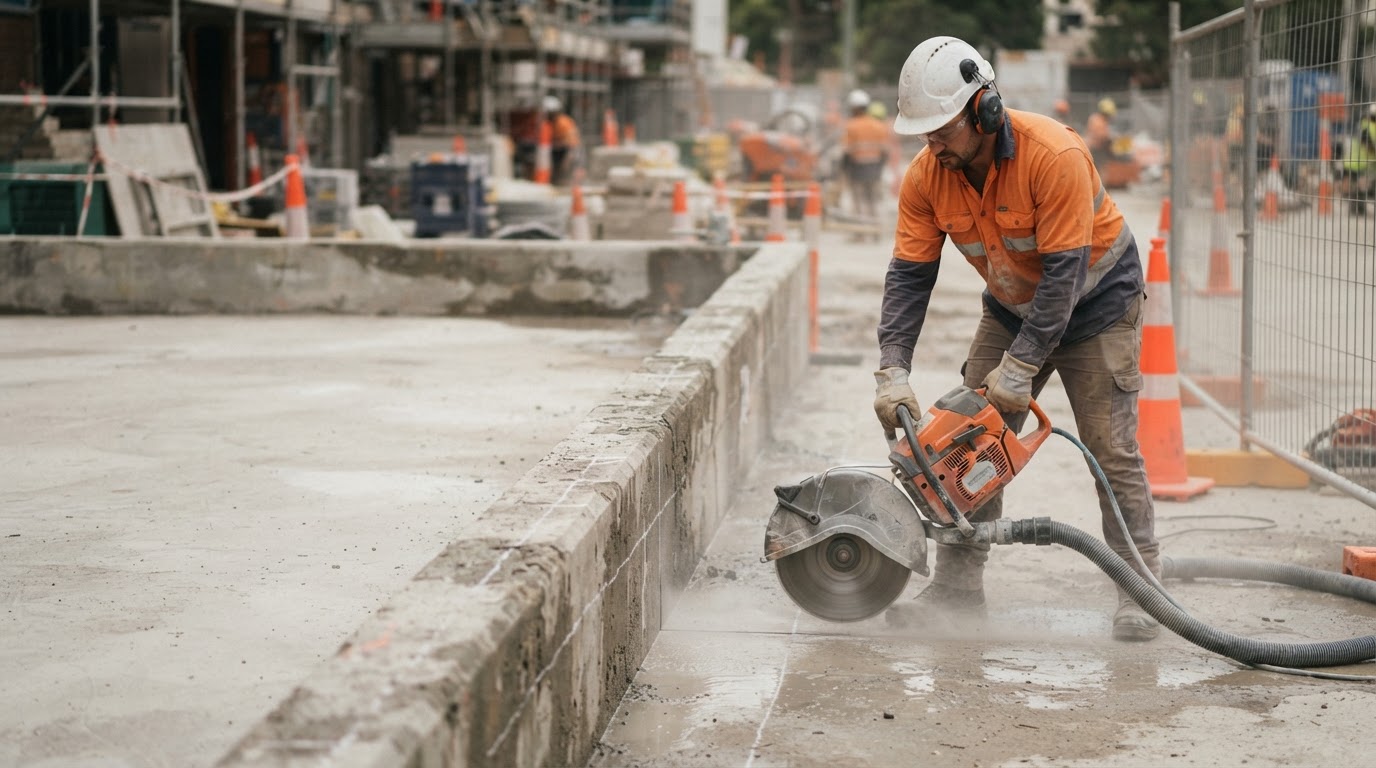
Best fit
When hand sawing may fit
The provider selects the final method only after the proposed work, concrete, access and risk controls are understood.
- Short cuts and edge trimming where larger machines cannot reach
- Small wall, slab or masonry openings within equipment capacity
- Finishing corners or connecting cuts from another sawing method
- Occupied or constrained sites that need a compact setup
Method and limits
Method, access and limitations
Hand saws provide mobility but still need firm stance, blade clearance and effective dust or slurry control. Cut depth is limited compared with larger equipment, and deeper openings may require cutting from both sides or changing to a ring saw, wall saw or core drill.
Treat dimensions as planning inputs until the actual structure, access and work conditions are checked. Engineering, service-location, permit and site-safety requirements still apply.
Details
Details to share with Jackie
The clearer the scope information, the more usefully we can connect your enquiry with a vetted local provider. These details help distinguish a straightforward cutting task from work that needs scanning, engineering, lifting, isolation or another specialist input.
- Show the cutting face, nearby corners and available working space
- Measure required line length and depth
- Identify sensitive finishes, residents or equipment near the work
- Confirm power, water, ventilation and exclusion options
Handoff
What happens after you start with Jackie
Jackie gathers the key job details, then we connect your enquiry with a vetted local concrete cutting provider. The provider reviews suitability, clarifies anything missing and confirms the actual scope, timing and terms directly with you.
Cost drivers
What changes the scope of a hand sawing enquiry
These drivers help explain why one cutting enquiry is simpler than another. They are not a price list.
| Job feature | Why it changes the scope | Useful detail to share |
|---|---|---|
| Number and length of cuts | Short isolated cuts differ from repeated detailed trimming | Marked photo with approximate dimensions |
| Required depth | Deeper work may need two-sided access or another method | Depth and whether both faces are reachable |
| Working position | Low, overhead, vertical or confined positions affect control and pace | Full-area photos rather than close-ups only |
| Dust or slurry controls | Indoor and finished spaces need capture, screening and clean-up | Whether wet cutting is permitted |
| Material transitions | Concrete, block, brick, render and steel each affect tooling | Known material layers and finish |
| Edge finish and follow-on work | A rough removal cut and a visible finished edge have different requirements | What will be installed or finished afterwards |
This is cost-driver guidance, not a quote. The preferred provider confirms scope, inclusions and any applicable GST before work is agreed.
Start with Jackie
Tell us about this job
Send the dimensions, depth, access photos and the intended outcome for this service. Jackie gathers the key details, then we connect your enquiry with a vetted local concrete cutting provider.
Open the chat to start your enquiry
Click below to open the conversation window and share your job details with Jackie.
Or call 0468 023 118Questions
Hand Sawing questions
How deep can a handheld concrete saw cut?
Depth depends on saw type, blade diameter, safe access and whether both sides are reachable. Deep work may be better suited to ring sawing or a track-mounted method.
Can hand sawing be used indoors?
It may be possible with appropriate ventilation, dust or slurry capture, protection and access controls. The occupied environment should be described before the method is selected.
Does a handheld saw make a square corner?
A circular blade naturally leaves an overcut or an uncut corner depending on the approach. Core drilling or another finishing method may be used where corner geometry matters.