
Core Drilling in Wollongong
Round, accurately positioned penetrations for pipes, cables, ventilation and testing.
Best fit
When core drilling may fit
The provider selects the final method only after the proposed work, concrete, access and risk controls are understood.
- Plumbing and drainage penetrations through slabs or walls
- Electrical, communications and mechanical service openings
- Ventilation, extraction or conduit penetrations
- Concrete sampling where a qualified project team specifies it
Method and limits
Method, access and limitations
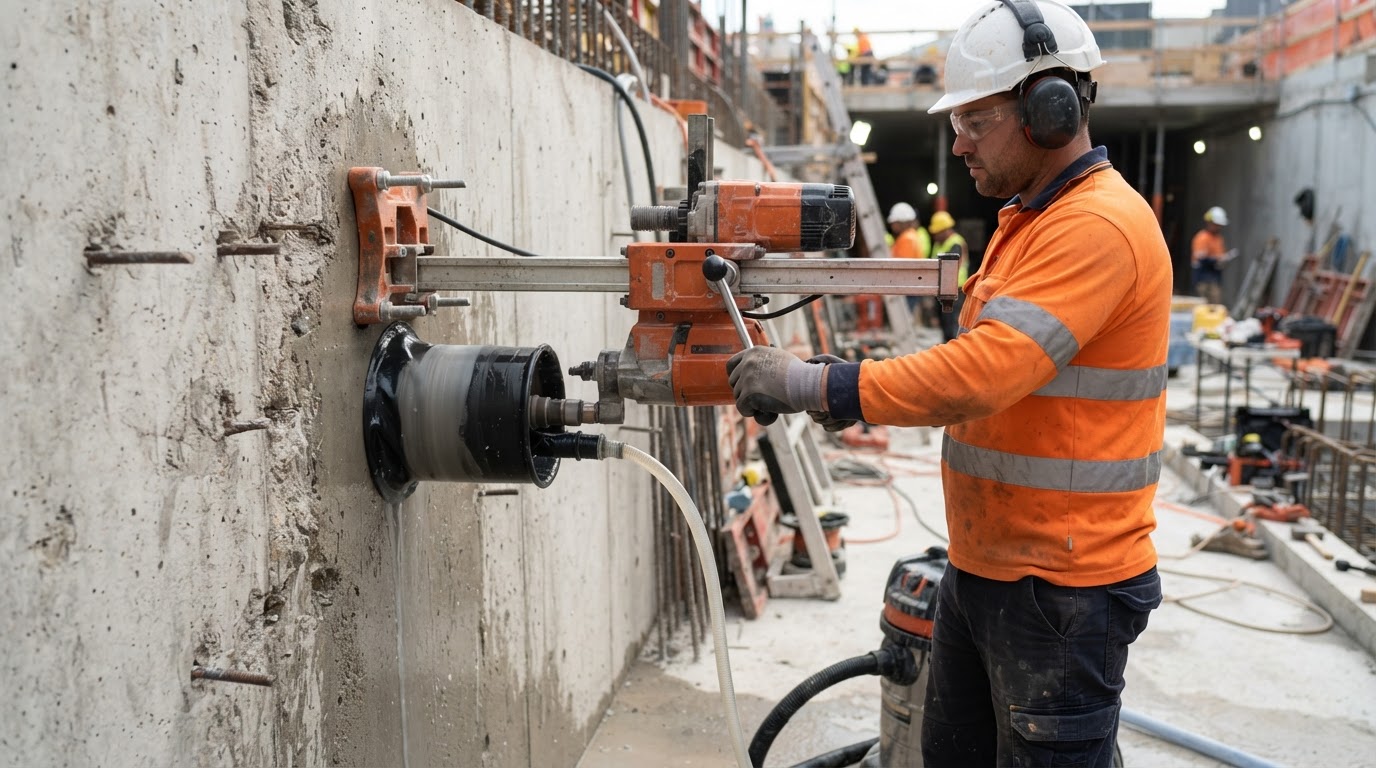
Core drilling uses a diamond barrel to produce a circular opening. Hole diameter, depth, drilling angle, substrate, reinforcement, service location and what lies beyond the surface all affect the plan. Overhead and wall drilling also need secure mounting, water capture and control of the core when it releases.
Treat dimensions as planning inputs until the actual structure, access and work conditions are checked. Engineering, service-location, permit and site-safety requirements still apply.
Details
Details to share with Jackie
The clearer the scope information, the more usefully we can connect your enquiry with a vetted local provider. These details help distinguish a straightforward cutting task from work that needs scanning, engineering, lifting, isolation or another specialist input.
- Provide the required diameter, depth and centre-point location
- Confirm what is on the opposite side of the wall or slab
- Share service plans and arrange scanning where hidden services may be present
- Explain whether the core must be retained, removed or sampled
Handoff
What happens after you start with Jackie
Jackie gathers the key job details, then we connect your enquiry with a vetted local concrete cutting provider. The provider reviews suitability, clarifies anything missing and confirms the actual scope, timing and terms directly with you.
Cost drivers
What changes the scope of a core drilling enquiry
These drivers help explain why one drilling enquiry is simpler than another. They are not a price list.
| Job feature | Why it changes the scope | Useful detail to share |
|---|---|---|
| Hole diameter | Larger diameters need larger barrels, more power and heavier handling | Diameter in millimetres for every penetration |
| Depth and substrate | Thicker concrete, masonry layers or hard aggregate extend drilling time | Estimated thickness and material build-up |
| Number and spacing of holes | Repeated holes may share setup, while close spacing can affect structural review | A marked plan or photo with hole centres |
| Drilling direction | Wall, floor, angled and overhead drilling use different controls | Orientation and access on both sides |
| Reinforcement and services | Known steel or hidden services can require scanning or relocation | Drawings, scan results or known service routes |
| Water capture and core control | Occupied or finished areas need stronger containment and protection | Room use, finishes below and permitted water path |
This is cost-driver guidance, not a quote. The preferred provider confirms scope, inclusions and any applicable GST before work is agreed.
Start with Jackie
Tell us about this job
Send the dimensions, depth, access photos and the intended outcome for this service. Jackie gathers the key details, then we connect your enquiry with a vetted local concrete cutting provider.
Open the chat to start your enquiry
Click below to open the conversation window and share your job details with Jackie.
Or call 0468 023 118Questions
Core Drilling questions
What hole sizes can be core drilled?
Core drilling can cover a broad range, but the practical diameter depends on available equipment, concrete thickness, reinforcement, access and the project specification. Give Jackie the diameter in millimetres rather than only the pipe size.
Can a hole be drilled at an angle?
Angled drilling can be possible when there is enough room to mount and control the equipment. The entry and exit points, depth and purpose should be confirmed before work.
Should the area be scanned first?
Scanning is prudent where services, post-tensioning, reinforcement or an unknown build-up could be affected. A scan reduces uncertainty but does not replace drawings, permits or engineering decisions.